Outsource Product Photo Editing Service to save time, reduce operational workload, and scale your eCommerce business efficiently. From product launches to large catalogs, professional photo editing ensures consistent, high-quality visuals. With clear brand guidelines and quality standards, you maintain full control over your brand’s image while focusing on sales, marketing, and business growth.
You can find all the explanations below. Just scroll down!
Table of Contents
What Is Outsourcing Editing?
Outsource editing means sending your photo post-production work to an external editor, studio, or professional photo editing service. It lets you tap into outside editors or studios to handle your e-commerce photo post-production. This way, your internal team doesn’t have to do every single edit themselves.
They follow your exact instructions and send back finished images. Those files are then ready for your website, marketplace, catalog, or ad campaigns.
The work can be as simple as removing a background or as detailed as high-end product retouching.
E-commerce catalogs are packed with repetitive edits. Outsourcing takes those routine tasks off your plate so you can focus on selling. Once the editing style is established, the same standards can be applied across large batches.
The important part is control.
Before starting, you should clearly define things such as:
- Background requirements
- Image dimensions and cropping
- Product positioning
- Color expectations
- Shadow style
- Retouching level
- File format
- Naming conventions
- Delivery schedule
- Marketplace requirements
Your editing partner must follow your exact instructions. They should never make creative changes that alter how your products actually look. That is why a good outsourcing workflow usually starts with sample images and clear guidelines. The sample gives both sides a chance to agree on the expected result before full production begins.
Common Photo Editing Tasks You Can Outsource
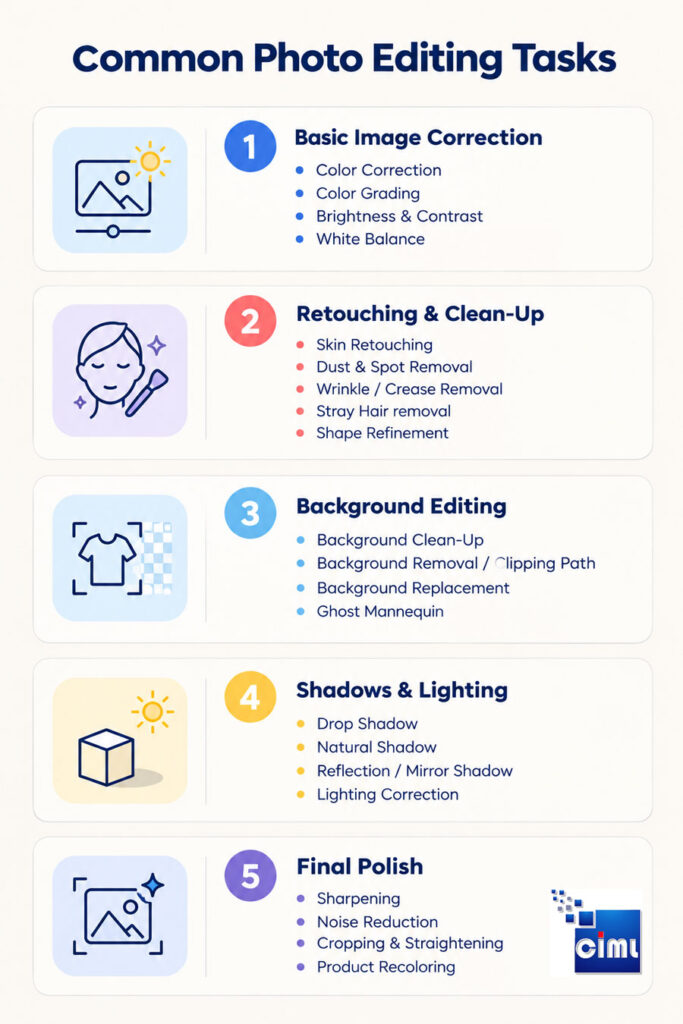
Background removal is just one aspect of e-commerce photo editing. You may assign many jobs to the same editing team, depending on your items and sales channels.
Background Removal
A plain background removes distractions. It keeps the buyer’s eyes right where they belong—on the product itself.
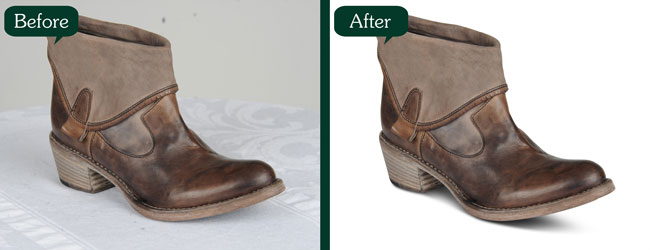
Editors can remove the original background and create a white, transparent, or other approved background. For products with simple edges, a clipping path may be enough. Hair, fur, fabric, glass, and other complicated edges may require masking.
Clipping Path and Image Masking
Clipping paths are useful for products with clear, defined edges. Complex details like hair, fur, feathers, or semi-transparent objects are better suited for image masking. Outsourcing these repetitive tasks can save your internal team considerable production time for larger catalogs.
Product Retouching
Product photographs often contain dust, scratches, fingerprints, small wrinkles, unwanted reflections, or other distractions.
Professional retouching can clean these issues while keeping the product realistic. The goal is a polished image. It should never make the product look different from what customers get in the box.
Color Correction
Accurate color matters when customers are buying from photographs.
Editors fix white balance, exposure, contrast, saturation, and light. This keeps every product photo matching across your shop. For products sold in multiple colors, consistent editing becomes even more important. Consistent color matters. A blue shirt must look the same in every photo, no matter the lighting.
Shadow and Reflection Creation
A completely flat product cutout can sometimes look unnatural. Depending on the brand style, you may want a soft drop shadow, natural contact shadow, or reflection. The important word is natural.
Shadows should support the product rather than distract from it. Your editing guidelines should specify the preferred style before production begins.
Ghost Mannequin Editing
Ghost mannequin editing hides the form. Your clothes look shaped and ready to wear, without any mannequin in sight.
Editors combine different parts of the photographed garment to create a clean, hollow-man effect. This can make apparel listings more informative while maintaining a consistent catalog appearance.
Cropping, Resizing, and Alignment
Different marketplaces and websites may require specific image dimensions.
An outsourced team can handle cropping, resizing, centering, alignment, and export according to your requirements. This is particularly useful when the same product needs image versions for several platforms.
Bulk Photo Editing
This is where outsourcing can make a major difference.
Instead of editing hundreds of photos one by one, you send the whole batch to a team that follows your approved rules.
A structured bulk photo editing workflow can include uploading the files, applying the editing guidelines, performing quality checks, and returning organized final images.
How to Outsource Photo Editing Without Losing Control
Treat your editing partner like part of your own team. They are not just someone who picks up files and sends them back.
- Start with a Small Test
Before sending thousands of images, send a representative selection. Test files should match your real catalog. If you sell jewelry, pick items with shiny reflections, tiny details, and mixed materials.
A test checks their work, speed, and communication. It shows you if they truly understand your rules.
- Create Clear Editing Guidelines
Your editing instructions should answer the questions an editor is likely to have.
For example:
Background: Pure white
Product position: Centered
Shadow: Soft natural contact shadow
Color: Keep original product color accurate
Crop: 1:1
Output: JPG, sRGB
Retouching: Remove dust and minor imperfections only
You can also provide approved before-and-after examples. Visual references often make your expectations much easier to understand.
- Approve the Style before Bulk Production
Do not wait until the entire batch is finished to decide whether the editing style is right.
Approve a few sample images first.
Once the look is approved, those files can become references for future batches. This reduces unnecessary revisions and helps maintain consistency.
- Keep Your Brand Guidelines Central
Your editor must know your brand. They should make every photo look like it belongs in your store.
If your brand uses a particular crop, background, shadow, color treatment, or retouching style, document it.
Different time zones can slow things down. Clear rules keep projects moving while you sleep. A clear written guide reduces dependence on repeated explanations.
- Set up Quality Control
Large-volume editing needs a quality-control process.
Editors should check things such as:
- Edges and background removal
- Product color
- Alignment
- Shadow placement
- Dust and unwanted marks
- Image dimensions
- File format
- Naming
- Overall consistency
Some professional editing providers use a separate QC stage before delivery. This can be useful when processing large batches because problems can be caught before the files reach your store.
- Keep Feedback Simple and Specific
When something needs correction, avoid saying only, “This doesn’t look right.”
Instead, explain exactly what needs to change.
For example:
“Reduce the shadow opacity and keep the product color closer to the original reference.”
Specific feedback is easier to apply and can be added to your permanent editing guidelines.
- Protect Your Files and Information
Product photographs can be commercially sensitive, especially before a new collection launches.
Ask where your files go. Know who can see them, how they are sent, and how long they stay on their servers.
If your business has specific confidentiality requirements, consider using an NDA and an agreed file-handling process.
- Track Quality over Time
Your first successful batch does not mean the process should be left unattended forever.
For ongoing projects, periodically review samples from completed batches. This helps identify changes in quality before they become a larger problem.
A simple scorecard can track:
- Accuracy
- Consistency
- Revision rate
- Turnaround
- File accuracy
- Communication
This gives you a practical way to measure the relationship instead of relying on assumptions.
How to Choose the Right Photo Editing Partner
Price matters, but it should not be the only factor. Cheap rates cost more if your team has to fix bad work.
When comparing providers look at:
| Factor | What to Check |
|---|---|
Editing quality |
Can they match your required style? |
Experience |
Have they worked with your product category? |
Scalability |
Can they handle your normal and peak volumes? |
Turnaround |
Can they meet your publishing schedule? |
Quality control |
Is there a defined review process? |
Communication |
Can you easily provide feedback? |
Revisions |
How are corrections handled? |
Security |
How are files transferred and stored? |
Pricing |
Is the rate suitable for your volume and complexity? |
Trial |
Can you test the service before a large order? |
When Should You Outsource Photo Editing?
Outsource when editing steals time from core work, or when your team cannot keep up with high photo volume.
You may want to consider it when:
- Your product catalog is growing quickly.
- You receive hundreds or thousands of images at a time.
- Your internal team spends too much time on repetitive Photoshop work.
- You need consistent editing across a large catalog.
- Seasonal launches create sudden editing peaks.
- You need specialist skills such as masking or advanced retouching.
- You want to increase production without hiring a larger in-house team.
It can also work well for photographers, creative agencies, and ecommerce teams that need a reliable production partner rather than a full-time editor.
Frequently Asked Questions
Is it safe to outsource product photo editing?
If you select a reliable supplier and establish clear file handling and confidentiality procedures. For commercially sensitive projects, discuss access, storage, transfer methods, and NDA requirements before sharing files.
How much does outsourced photo editing cost?
There is no single rate for every project. Pricing usually depends on the type of editing, image complexity, volume, turnaround time, and required output. Simple background removal generally requires less work than detailed product retouching or complex masking.
Can I outsource bulk photo editing for thousands of images?
Yes. Bulk photo editing is one of the common reasons businesses outsource. The key is to establish the editing style, workflow, and quality standards before production begins.
Will outsourcing make my product images look inconsistent?
It should not if the workflow is properly managed. Provide clear guidelines, approved references, and sample edits, and use quality control throughout production.
Should I outsource all my photo editing?
Not necessarily. You can outsource repetitive or high-volume tasks while keeping more creative or sensitive work in-house. The right balance depends on your team, volume, budget, and workflow.
Is offshore photo retouching a good option for ecommerce businesses?
It can be useful when you need additional production capacity, specialist editing skills, or flexible support across time zones. However, the provider’s editing quality, communication, security, and consistency in following your instructions are more important than its location.
How can I test an editing company before committing?
Ask for a small sample edit using representative images from your actual catalog. Compare the result with your requirements and assess communication and turnaround alongside the visual quality.
Final Thoughts
Outsourcing photo editing helps you save time while maintaining consistent, professional product images. At Cutout Image Media Limited, we provide reliable Outsource Photo Editing Services for Ecommerce Products, including background removal, retouching, clipping paths, and color correction.
If you like our blog and need quality photo editing services, feel free to contact us! If you find this blog helpful, please share it with your photography community to help others benefit from it too.